Evaluating India’s Gains from the China+1 Strategy (2019–2024)
A research-driven analysis of how global supply chain diversification away from China has impacted India’s exports, manufacturing, and trade dependency.
Abstract
India’s trade patterns from 2019–2024 reflect a partial shift under the China+1 strategy. This study analyzes export competitiveness, changing trade partners, sector-level gains, and supply chain realignment with a focus on FDI and manufacturing resilience.
Objectives
- Track India’s export–import trends (2019–2024)
- Analyze dependency on China vs China+1 nations
- Evaluate sector-wise shifts using HS2 trade classification
- Examine FDI flows into manufacturing
Data & Methodology
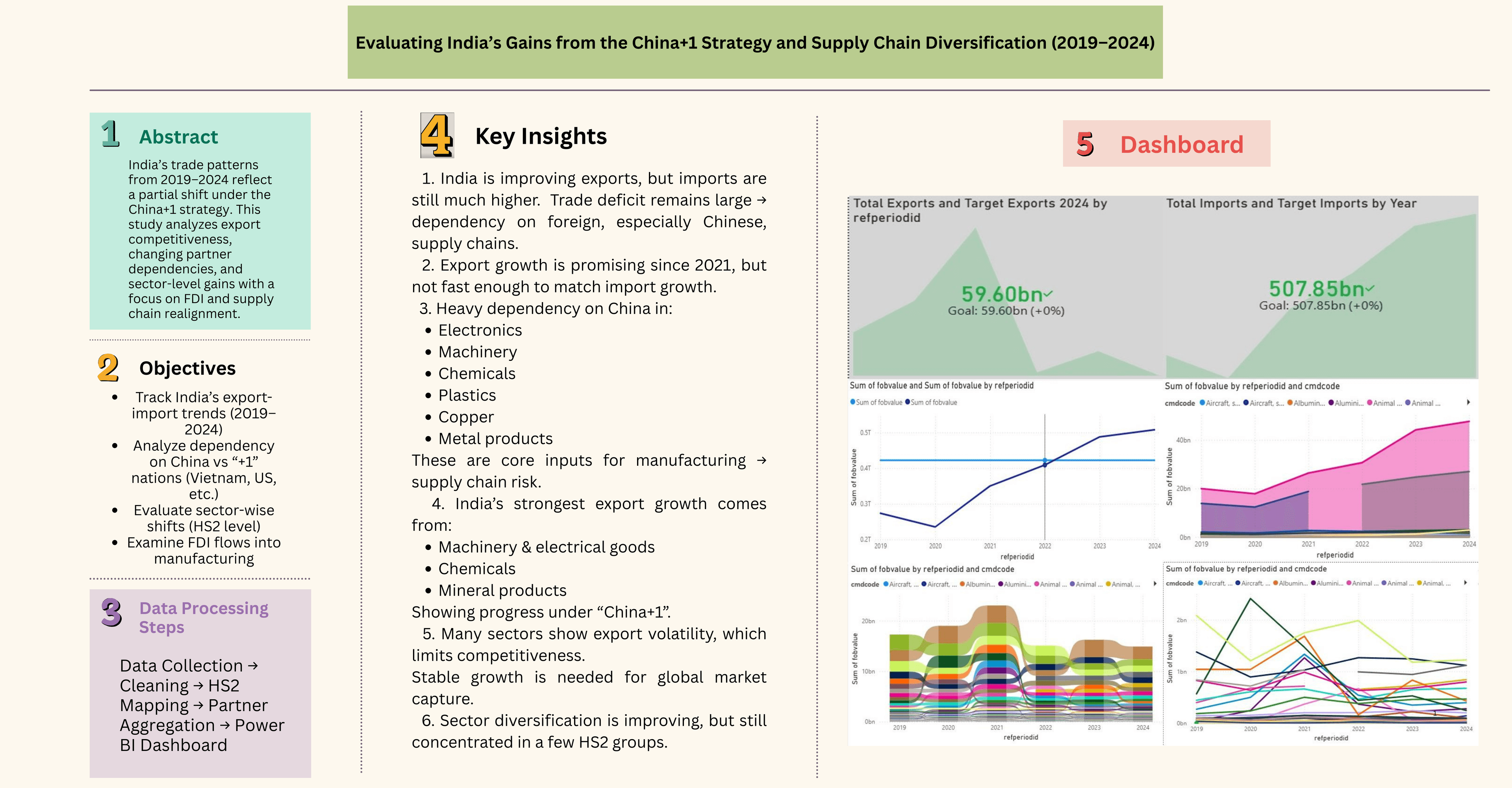
Trade data was sourced from the UN Comtrade database and mapped to HS2 product codes. The data was cleaned, normalized, and aggregated by year, partner country, and sector. Power BI was used to build an interactive dashboard tracking exports, imports, and China-dependence over time.
Key Insights
- India’s exports are improving, but imports still dominate, keeping the trade deficit high.
- Export growth accelerated after 2021, but not fast enough to offset import dependence.
- Heavy dependence on China remains in electronics, machinery, chemicals, plastics, and copper.
- Strongest export growth is seen in machinery, electrical goods, chemicals, and mineral products.
- Sector diversification is improving but remains concentrated in a few HS2 groups.
Power BI Dashboard
Conclusion
The China+1 strategy has clearly benefited India, especially in manufacturing exports and foreign investment. However, structural dependence on China for critical industrial inputs remains a key risk. Sustained policy support and sectoral diversification will be essential for India to fully capitalize on global supply chain realignment.